Optical Design
To achieve the maximal performance of a telescope it has to be designed for the observation application of the user. Based on the application of the customer we define the specifications and develop the optical system to ensure the best possible telescope characteristics.
Important factors of the telescope design is besides the type the aperture, obstruction, f-number, field of view, the application type as visual observations of planets or e.g. photographic use with CCD systems.
Two examples below show simulation calculations for a Cassegrain system and a telecentric system for an H-alpha filter working with an 8" refractor. Both optical systems have been realized und work as expected.
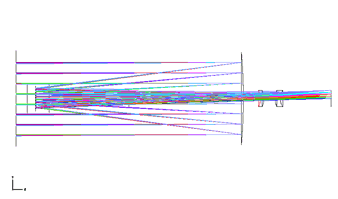 |
Ray path for a Cassegrain F12 with Baffle system for creating vignetting diagrams, spot diagrams and point spred function. |
 |
 |
||
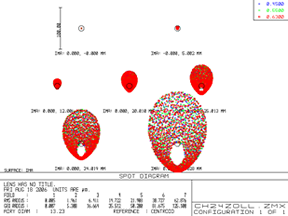
| Spot diagram for a Cassegrain F12 system without a corrector at a focal lenght of 7200mm. Here the diffraction limited field oh view is finally only 12mm. This can be proved simple by comparing the spots in respect to the airy disc, which defines the diffraction limit. |
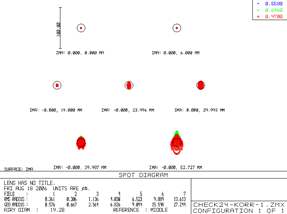
Spot diagram for a Cassegrain F12 corrector. The diffraction limited field of view is now extended to 80mm. The focal length of the telescope is expanded to 8.5m (18% enlarged). The field of view for visual and photographic observations is 104mm in diameter or 42 arc minutes. | ||
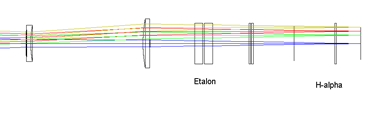 |
Ray path for a telecentric H-alpha system by Lille (http://mitglied.lycos.de/LilleSonne/). The telecentric optic reduces the beam divergencxe to maximal 0.13°. |
||
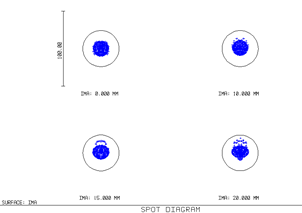 |
The spot diagram for the telecentric system proves that the optocs is refraction limited over the whole field of view. The circles around the spots show the airy disk describing the maximal limit for the dot in case of a refraction limited optics. |
Design und Realisierung von Okularen für langbrennweitige Telskop-Systeme.
Telekope mit großer Öffnung
haben meisten längere Brennweiten. Die üblichen 2" Okulare
haben mit den maximal 45mm Durchmesser begrenzten Gesichtsfeldern den
Nachteil, daß der beobachtbare Himmelsausschnitt deutlich kleiner
als 30' ist.
Für Teleskop Systeme mit einem Öffnungsverhältnis F = 12
oder größer wird aus diesem Grund ein Okular mit 100mm Gesichtsfeld
und einer Brennweite von 75mm entworfen und realisiert.
Damit errechnet sich z.B. Gesichtsfeld des 24" Cassegrain Systems
bei einer Brennweite von 8.5m zu 40' bei einer Austrittspupille von 5.4mm.